
Introducing Palindrick
I published this on 22/02/2022. Write the date day first and it reads the same backwards. Americans get 2/22/22 which works too. ISO gets 2022-02-22 and ruins it.
That was sign enough to write down a form I'd been playing with. It's a limerick with one extra rule.
The fifth line has to be a palindrome.
I call it a palindrick.
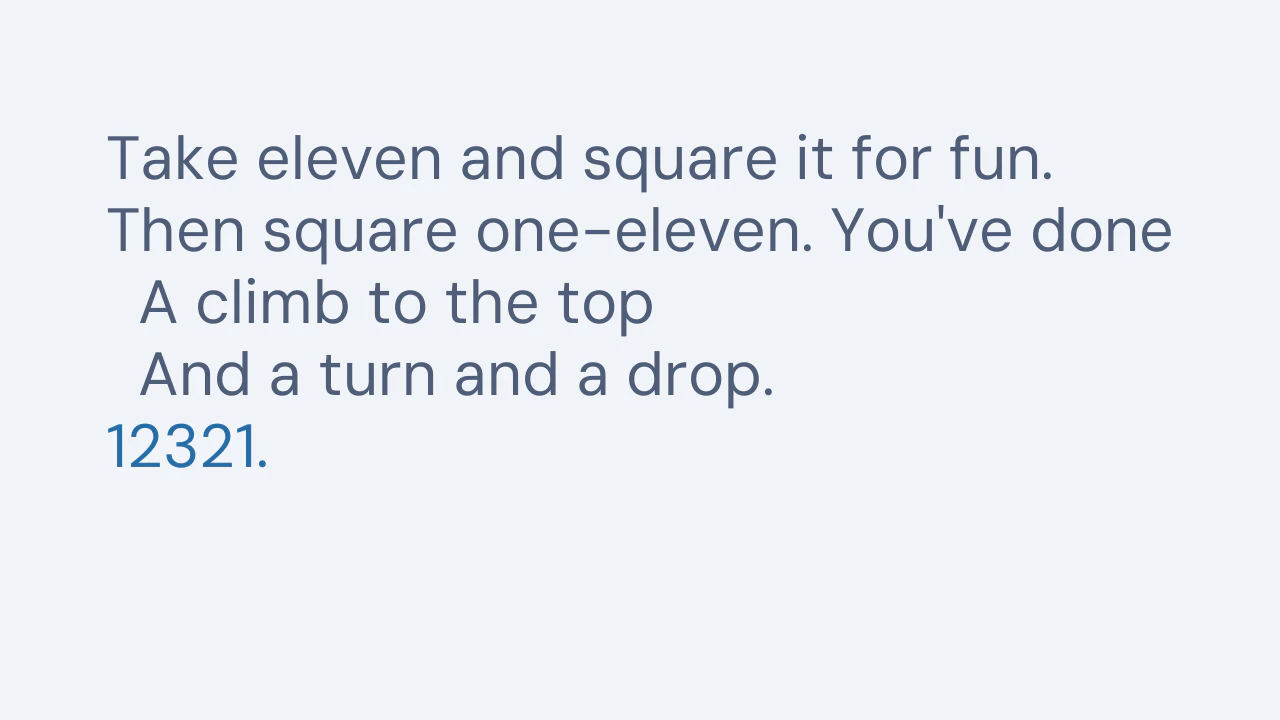
Take eleven and square it for fun.
Then square one-eleven. You've done
A climb to the top
And a turn and a drop.
12321.
Read the last line aloud and it rhymes (“twelve thousand three hundred and twenty-one”). Read it on the page and it's a palindrome.
Everything else comes from the limerick. Five lines rhyme AABBA. Lines one, two and five bounce along on three beats (da-da-DUM da-da-DUM da-da-DUM) and lines three and four are shorter. The palindrome gets a pass on meter because surviving a reading in reverse is hard enough without counting syllables too.
Wordplay people got here first and went further. Word Ways has run pieces on the palimerick where the whole limerick reads the same backwards. Those are heroic. The palindrick is their lazy cousin and only asks for one line.
My first one bent a classic of unknown origin and borrowed an old palindrome for the punch line:
The limerick packs laughs deepen
Into space that is quite like heaven.
But the good ones I've seen
So seldom are clean
Never odd or even.
A man, a plan, a canal
Leigh Mercer (1893–1977) was a British wordplay obsessive who went through at least sixty jobs and never learned to drive. He drafted palindromes on index cards his employer Rawlplug had thrown away. On 13 November 1948 Notes and Queries printed the one that stuck:
A man, a plan, a canal: Panama!
He also made limericks out of numbers. Read 1,264,853,971.2758463 aloud and you get this:
One thousand two hundred and sixty
four million eight hundred and fifty
three thousand nine hun-
dred and seventy one
point two seven five eight four six three.
The man who turned a number into a limerick also wrote the most famous palindrome in English. He had both halves of a palindrick. As far as I know he never put them together… so here's his line back:
Leigh Mercer, a man without drama,
Filled the cards his firm binned with grammar.
He wrote left to right
Then back through the night.
A man, a plan, a canal: Panama!
Mad math
Who says there's no poetry in mathematics? Mathematicians write limericks all the time. The palindrome just makes them work for it.
One more from yours truly,
The lift fits eight people, built thin.
So of course a ninth squeezes in.
By the pigeonhole law
Someone's elbow meets jaw.
Nine men in.
The 12321 up top isn't a fluke either. Square a run of ones and the digits climb up and back down:
1²         = 1
11²        = 121
111²       = 12321
1111²      = 1234321
11111111²  = 123456787654321
111111111² = 12345678987654321
Ten ones and the carries wreck it. 1111111111² is 1234567900987654321.
Your turn. Four lines of limerick are easy. The fifth has to survive being read backwards.
More light verse for the road:
- Leigh Mercer on Wikipedia
- Mathematical mayhem, Donald Simanek's collection of math limericks and the source of Mercer's number limerick
- Physics limericks from Harvard
- Limericks for mathematicians by Math with Bad Drawings
- Equation limericks on Math Stack Exchange
- Double dactyl and McWhirtle, two more fixed forms for light verse
Read next
 Wrong Boot (codename: wrong8007)A programmable dead man's switch for Linux, living entirely in kernel space.
 Have a jalebi.An experiment in spirals, sine waves, and handcrafted chaos in C.
 Do things that eventually scalePaul Graham's legendary advice is often misunderstood. Here's my take on what it really means.