
Address bar spoofing in Firefox Lite for Android ...and the idiocy that followed
First published on my old blog, Tinkering the kernel, in 2020.

Date reported — 2019-08-29
Summary
Firefox Lite 1.9.2 for Android and earlier suffer from exhaustive Address Bar Spoofing, allowing attackers to potentially trick a victim into visiting a malicious domain under a legitimate domain name. Firefox Lite is installed on more than 10M devices.
Impact
URL Address Bar spoofing is the worst kind of phishing attack possible because, for a non-technical user, the address bar is the only way to identify the site they're visiting. It's the only way to trust a website and if this indicator is hijacked, the whole security of any normal user is compromised.
Explanation
The address bar can be spoofed by a crafted JavaScript page with a setInterval() function which executes a pwn() function which ultimately reloads the target URL every 10ms.
Proof of concept (POC)
- Opening Firefox Lite; Latest version i.e. 1.9.1 (13361)
- Spawning a HTTP web-server with the attached payload i.e.
spoof.html - Loading the page e.g http://10.10.10.10/spoof.html
- URL gets spoofed and shows contents of
spoof.htmlwhile URL points at https://www.mozilla.org/en-US/
Expected behavior
The browser should successfully redirect to the target website.
Reply from Mozilla
Quickly acknowledging, validating, and resolving submitted issues while recognizing the researcher's effort is vital for successful vulnerability coordination, but the report didn't get any attention after the initial triage and half-hearted discussion.
…11 months later
I got fed up after waiting for months, eleven months to be exact. I emailed security@mozilla.org asking them to look at the stale bug report.
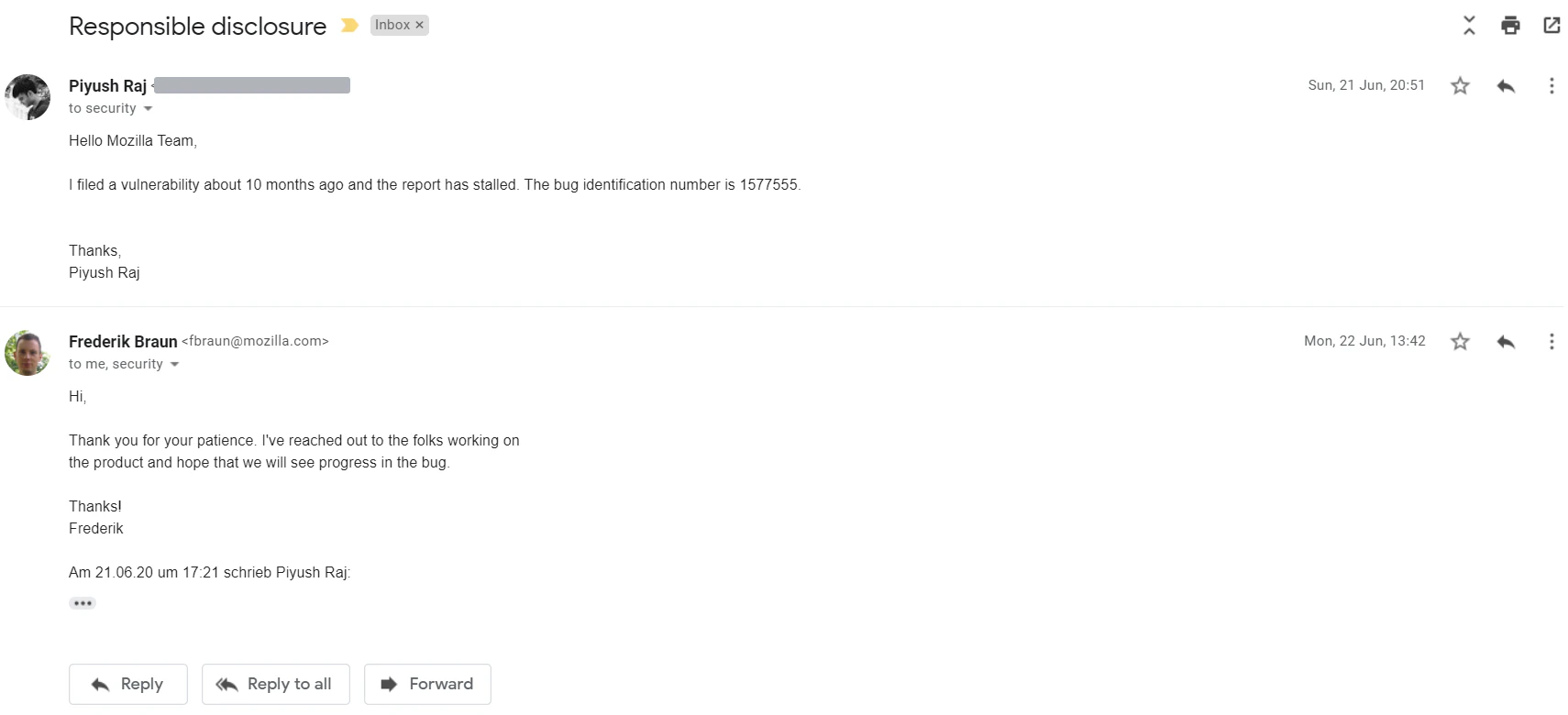
Frederik helped to re-initiate the stalled report. This is what happened afterwards —
Sitting on the report for 11 months while Google's webview versions were regularly updated then establishing low impact is scummy behaviour.
I don't think the reply needs any more explanation. I leave it up to you to judge the response. I'm not gonna do anything now. Let's see what happens.
Peace out.
Read next
 OS Command Injection on Node.JS Jison moduleDiscovering an OS command injection vulnerability in Jison parser ports that allows arbitrary shell command execution.
 How I Hacked Samsung's Tizen OS & LG Electronics Private Project Management InstancesA flaw hackers can use to access Samsung’s and LG Electronics internal bug tracking project management instances running on Jira.
 Sensitive Data Exposure over *.unesco.org, thanks to OptionsBleed for low-hanging fruitOptions Bleed is a use after free error in Apache HTTP which helped in seeking the direct leak of sensitive data through a misconfigured server-status module.